
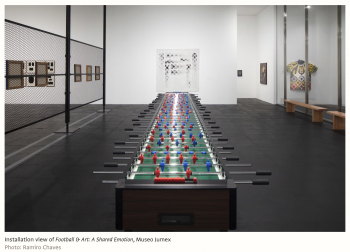
As the 2026 World Cup gets into gear across the United States, Canada and Mexico, museums in all three host nations have filled their galleries with football. The Art Newspaper has tracked the wave of games-themed shows, a form of cultural diplomacy and common ground at a moment when relations between the three neighbours are strained. Behind several of the largest is a sponsor, making its own mark.
The Pérez Art Museum Miami is showing Get in the Game, more than 100 works on how sport shapes identity and memory, presented by Bank of America, the official bank of the tournament. In Toronto, The Power Plant has turned its gallery into a playground with Colourful Parachutes, a children's exhibition supported by TD Bank Group, while the Aga Khan Museum traces games across centuries in Game On!, sponsored by the hospitality group Sunray. A mile from the AT&T Stadium in Arlington, its Museum of Art has built More Than a Match, not one but four exhibitions around World Cup memorabilia, historic maps and a community wall of fans' match-day scarves, backed by Texas banks, law firms and property developers. Across New York and New Jersey, 23 artists have decorated soccer-ball sculptures in the now-ubiquitous city art-trail format, which still enlivens public space and gives artists and local sponsors an accessible way in. Mexico City has gone further, commissioning more than a thousand murals across its neighbourhoods, many drawing on the ancient Mesoamerican ball game and putting local artists at the centre of the city's welcome.
As the sponsoring brands know, sport is one of the few subjects that crosses every border, and art is another; together they pull audiences toward bigger questions - identity, belonging, travel and migration, and the plain and pleasure of play. A World Cup is also one of the largest commercial machines on earth, and art gives it a human scale: with galleries providing a place to pause and reflect amid the spectacle. It takes a global event and makes it local and it draws people into museums who might never otherwise come.
Cities and the major events invest in culture for good reasons. For a few weeks a host city holds the world's attention, a rare chance to project its identity and creativity to visitors and residents alike. The art around the tournament is mostly free, reaches people who will never hold a match ticket, and lasts beyond the final whistle. The Olympic charter makes a cultural programme compulsory. Birmingham's 2022 Commonwealth Games ran a six-month festival of 29 commissions that reached millions, with grants in every ward of the city. This summer, Glasgow's Commonwealth Games will carry a ten-week festival of more than 150 mostly free events, a £1.25 million community fund, and the city's contemporary art biennial. Each time, a global moment becomes a way to celebrate local culture and leave something for the people who live there.
There is more opportunity here for sponsors than is currently being realised. The cultural programming around these events is still funded mainly by public bodies, lottery money, arts councils and city cultural offices, while commercial partners cluster around the competition itself. Art offers what brands invest a host-city partnership to achieve - standing in a community, a part in its civic life, hospitality with substance, and earned credibility. A presenting credit gives some of it but enabling the work - commissioning it, convening people around it, broadening audiences - earns far more.
Bank of America, TD and the firms behind these exhibitions are doing this. They have put their names beside art that gathers people and gives a host city a way to show the world who it is. The goal is open for sponsors to do more.